
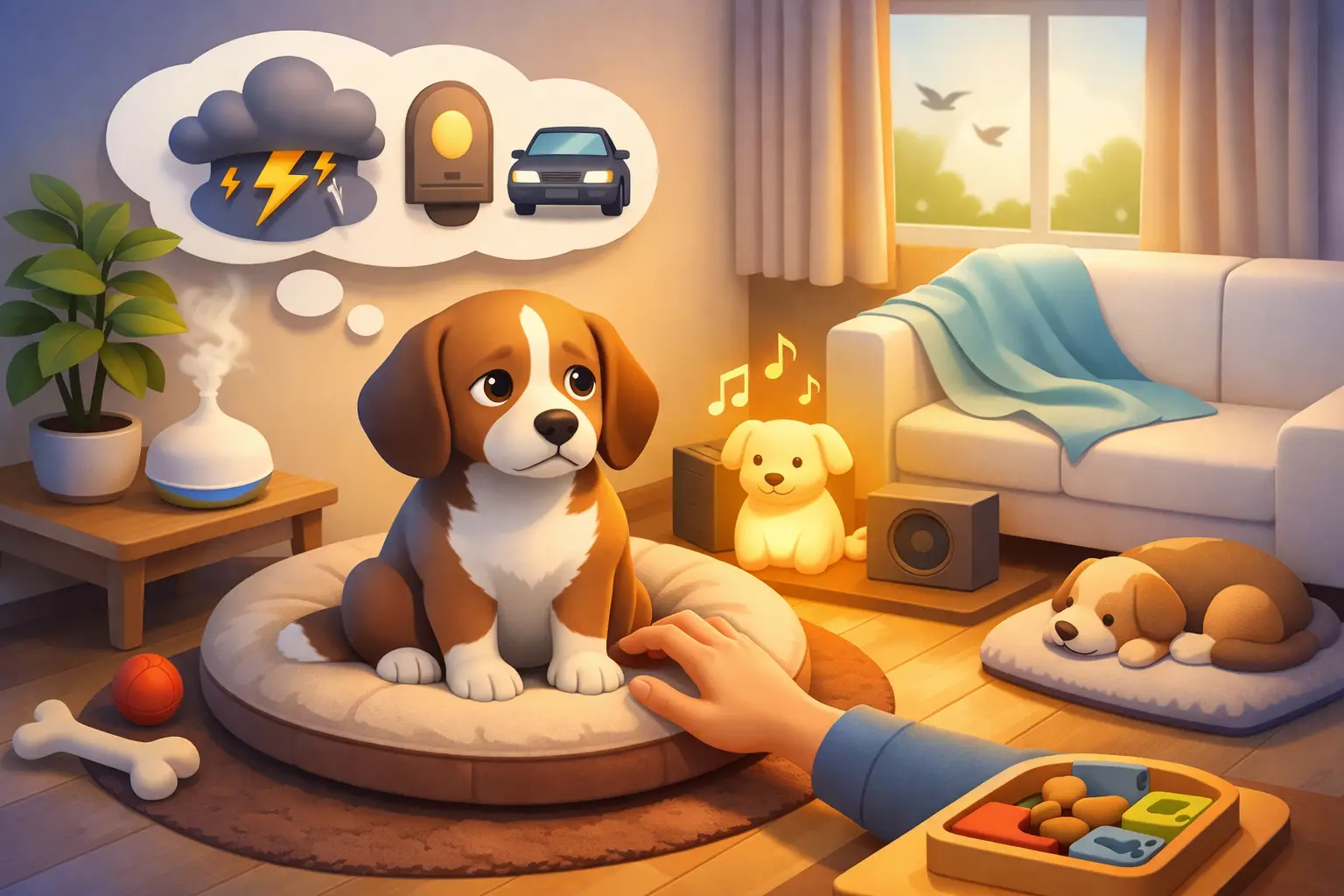
Your dog starts pacing the moment you pick up your keys. Or maybe the problem shows up at night – whining, restlessness, shadowing you from room to room, then a full meltdown when the house gets quiet. If you are wondering how to reduce dog anxiety at home, the best place to start is not with a quick fix. It is with your dog’s daily environment, because anxiety usually grows in the gaps between routine, stimulation, rest, and feeling safe.
A calmer dog is rarely the result of one miracle product or one training trick. It usually comes from a home setup that makes life more predictable, more enriching, and less overwhelming. That is good news for pet parents, because it means there is a lot you can improve without leaving your living room.
Anxious dogs do not all look the same. Some bark, scratch doors, chew furniture, and panic when left alone. Others go quiet and clingy. You might notice lip licking, yawning when they are not tired, shaking, pacing, hiding, accidents indoors, or a sudden refusal to settle.
The pattern matters more than any single behavior. If your dog only gets worked up during thunderstorms, that points to a different kind of stress than a dog who seems on edge all day. Separation anxiety, boredom, fear-based anxiety, noise sensitivity, and change-related stress can overlap, which is why broad advice often falls flat. A dog that needs more enrichment will not improve the same way a dog that is frightened by every hallway sound.
Dogs do better when they can predict what happens next. That does not mean your home needs to run like a military schedule, but it does mean meals, walks, play, rest, and departures should feel consistent enough that your dog is not constantly guessing.
Start with the basics. Feed at roughly the same times. Build in at least one daily decompression walk, not just a rushed bathroom break. Create a regular wind-down period in the evening with lower lights, less noise, and fewer stimulating interactions. Many dogs act anxious when they are actually overstimulated and overtired.
If your schedule is chaotic, focus on anchors instead of perfection. Morning potty, breakfast, mid-day enrichment, evening walk, bedtime routine – those predictable touchpoints can make the whole day feel safer.
Some homes accidentally keep dogs on high alert. A TV blasting in one room, delivery noise at the door, slippery floors, no quiet corner to retreat to – all of that adds up.
Give your dog a defined calm zone. It can be a crate if your dog already loves it, or a bed in a quiet corner with soft support, a familiar blanket, and a favorite chew. The goal is not confinement for its own sake. The goal is creating one area that consistently signals rest.
Pay attention to sensory load. Dogs who react to every outside movement may do better with partially covered windows or a bed placed away from the front door. Dogs who struggle to settle may benefit from lower household volume in the evening. Even simple changes like better traction on slick floors can reduce tension in nervous dogs who never quite feel physically secure.
This is also where thoughtful tools can help. Snuffle mats, lick mats, calming toys, and long-lasting chews do more than occupy time – they support self-soothing. That said, the right tool depends on the dog. A high-energy chewer may need something durable and engaging, while a noise-sensitive senior may benefit more from comfort and routine than stimulation.
A lot of anxious behavior is fueled by unused mental energy. A dog that spends most of the day under-stimulated can look worried, destructive, or needy when what they really need is a job.
But there is a trade-off here. More activity is not always better. Some anxious dogs get more wound up with high-intensity fetch sessions or nonstop excitement. The better approach is balanced enrichment – sniffing, licking, problem-solving, light training, and species-appropriate play.
Food puzzles are especially useful at home because they turn meals into mental work. Scatter feeding, stuffed toys, and simple training games can create focus and satisfaction. Scent work is another strong option. Hide treats around one room and let your dog search. It is low-cost, easy to repeat, and often more calming than hyped-up play.
If your dog seems frantic rather than fulfilled after activity, dial back intensity and increase calming enrichment. Think less chaos, more purpose.
If your dog panics when you leave, the solution is not to keep disappearing for long stretches and hope they adjust. For many dogs, that only rehearses the fear.
Instead, teach calm separation in tiny steps. Walk to the door, then sit back down. Pick up your keys, then make coffee. Step outside for ten seconds, then return before your dog escalates. The point is to break the link between departure cues and panic.
This part requires patience because progress is rarely linear. Some dogs improve quickly with short daily reps. Others need a much slower approach. If your dog is already in full distress every time you leave, training should stay below that panic threshold as much as possible. Once a dog is crying, scratching, or spiraling, learning drops off fast.
It can also help to reserve a special chew or food activity for these brief practice sessions. Over time, your dog starts to associate your movement around the house and short exits with something safe and rewarding instead of alarming.
Dogs are excellent readers of human patterns. If you tense up every time your dog startles, rush over with worried energy, or create a dramatic goodbye routine, your dog may learn that those moments really are a big deal.
Calm support works better than anxious reassurance. That means using an easy voice, moving normally, and rewarding the behavior you want – lying down, pausing, checking in, choosing the bed. You do not need to ignore your dog, but you do want to avoid accidentally amplifying the moment.
For households with multiple people, consistency matters. If one person rewards calm and another hypes the dog up constantly, progress gets messy. A shared approach usually works faster.
Not every restless or clingy dog has a training problem. Pain, digestive discomfort, hearing changes, cognitive decline, and skin irritation can all look like anxiety. If the behavior appeared suddenly, worsened quickly, or came with appetite, sleep, or bathroom changes, a veterinary check is the smart move.
This matters especially for older dogs. A senior who paces at night may need medical support, not just more enrichment. The same goes for dogs whose anxiety is severe enough to cause self-injury, escape attempts, or nonstop distress.
Home strategies can make a major difference, but there are cases where behavior support and veterinary guidance should work together. That is not a failure. It is often the most compassionate path.
If you want a more organized approach to how to reduce dog anxiety at home, think in layers rather than single solutions. The most effective homes for anxious dogs usually combine a few simple elements: a predictable routine, a true rest zone, calming enrichment, and short training sessions that build confidence.
It also helps to look at transitions. Mornings, departures, delivery times, evenings, and bedtime are common stress points. Improve those windows first. A lick mat during work calls, a puzzle feeder before you leave, or a quiet bedtime ritual can have an outsized effect because it targets the moments your dog finds hardest.
Brands like Idylle Shop speak to this modern version of pet care well – not as overcomplication, but as better systems for a calmer home. When the setup is thoughtful, daily life gets easier for both of you.
Most dogs do not go from anxious to perfectly relaxed overnight. The first signs of improvement are often subtle. Your dog settles five minutes faster. They recover more quickly after a noise. They choose the bed instead of following you into every room. Those small shifts matter because they show your dog is starting to feel safe enough to rest.
If you keep chasing instant results, you will miss the real win, which is a home that asks less of your dog’s nervous system every day. Give that process some room. A calmer dog is not built through pressure. It is built through repetition, comfort, and a routine that finally feels easy to trust.

We’re here to help! Find quick answers or reach out to our team anytime.







Leave a comment